Giza & Saqqara
Egypt · walked October 2024
I went in expecting to feel certainty, one way or the other. I came out with a longer list of questions than I brought.
- Latitude
- 29.9792° N
- Longitude
- 31.1342° E
- Alignment
- true north, <0.07°
- Attributed
- c. 2560 BCE
- Open questions
- 7 logged
The square is the pyramid's base, to scale of orientation only.
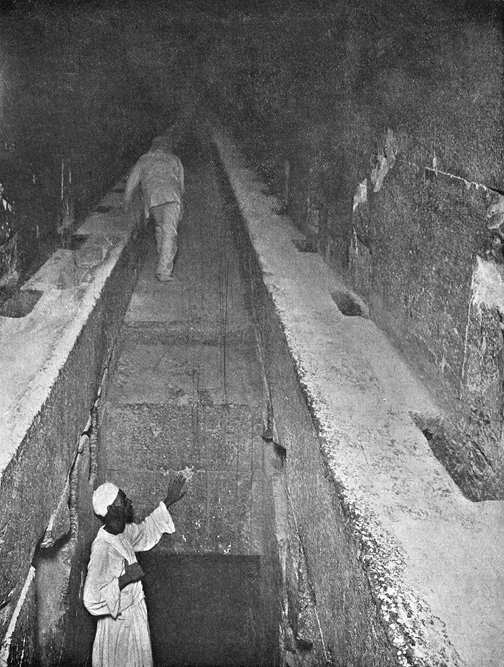
Standing in the King's Chamber
You climb the Grand Gallery bent double, in a queue, breathing other people's air. It smells of stone and sweat. Then the passage opens and you are inside a room of polished red granite, and every conversation in it goes quiet within about ten seconds. I have never seen a group of tourists fall silent that fast anywhere else.
The room is almost empty. A lidless granite box against the west wall, scarred at one corner. Walls that meet at angles you could check with an instrument. Above your head, out of sight, five stacked relieving chambers nobody was meant to see.
The granite came from Aswan, roughly 800 kilometres upriver. The largest beams over that ceiling weigh in the region of fifty to eighty tonnes. They were floated north, hauled up onto a plateau, and lifted some forty-three metres into the interior of a building that was still being built around them.
I keep being told this is understood. Standing under it, I could not make the explanation and the object meet.
I want to be careful here, because this is exactly the point where a certain kind of writing takes off and never comes back. So let me be plain about what I am claiming: nothing. I am recording that the gap between the account and the artefact felt wider in person than it does on paper. That is a feeling, not evidence. What follows is the evidence.
What is actually there
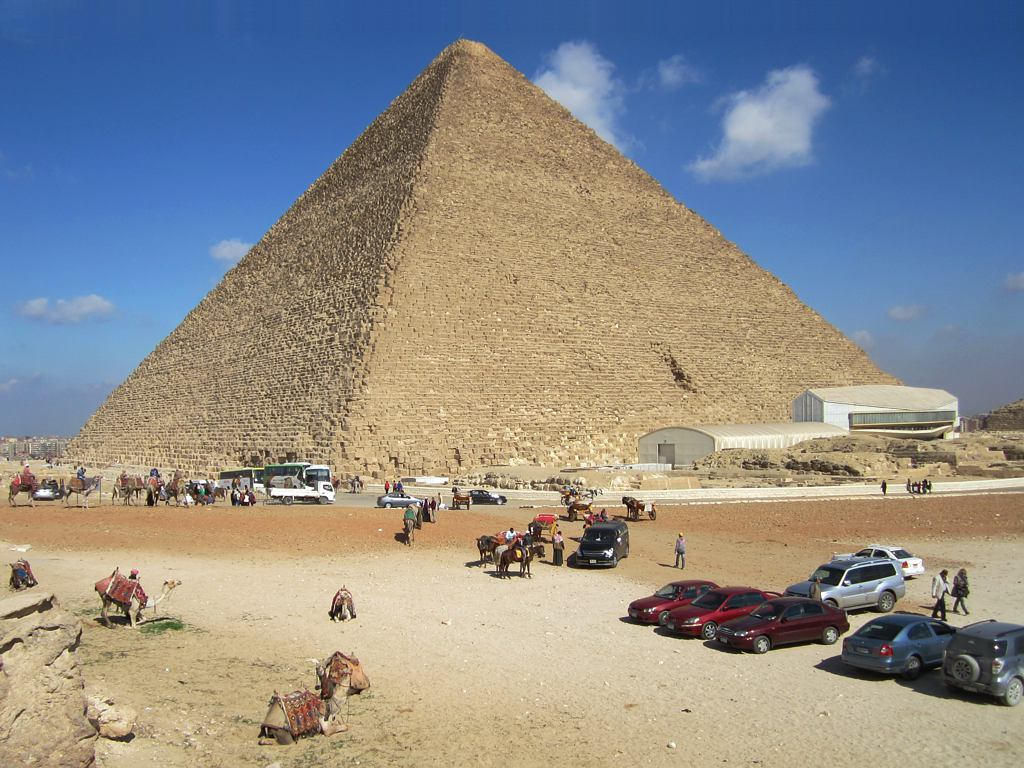
Three main pyramids, built across roughly three generations of the Fourth Dynasty, attributed to Khufu, Khafre and Menkaure. The Great Pyramid stood around 146.6 metres and now stands closer to 138.5, having lost its outer casing to later builders. Each base side runs about 230.3 metres, and the four sides differ from one another by a matter of centimetres.
Around them: queens' pyramids, boat pits, mastaba fields, causeways, a workers' settlement with bakeries and a cemetery, and the Sphinx in its quarried enclosure. This was not a monument dropped on empty desert. It was an industrial landscape.
And since 2013 we have something we did not have for four thousand years: paperwork. At Wadi al-Jarf on the Red Sea coast, excavators found papyri including the logbook of an inspector named Merer, who ran a team ferrying fine limestone from the Tura quarries to Giza. It is administrative, tedious, and extraordinary: the day to day shipping records of the Great Pyramid's construction, written by someone who was there.
That document settles a real argument. Whoever raised this, it was organised, salaried, catered Egyptian labour, working to a schedule. Any account that requires the builders to have been someone else has to explain Merer away, and I have not seen one that does.
The sky here
The pyramid's sides are aligned to the cardinal directions to within a few arcminutes, under a fifteenth of a degree. There is no magnetic compass that could do this; magnetic north is nowhere near accurate enough. It has to have been done astronomically, from the stars or the sun.
The leading explanations are elegant and low-tech: sighting the rising and setting points of a circumpolar star and bisecting the angle, or tracking the tip of a vertical rod's shadow through a day. Glen Dash has argued the small residual error across Giza's pyramids tilts in a consistent direction, which would fit a solar method used on a particular day of the year.
What I find genuinely interesting is not that they achieved it. It is that they cared enough to. Nothing about a tomb requires this. The alignment cost them time and skill and bought them no structural advantage. It bought meaning, and we no longer know what the meaning was.
What is still open
How were the heaviest stones raised?
Merer's logbook tells us how limestone got to the site. It does not tell us how a seventy-tonne granite beam got forty metres up. Proposals include long external ramps, spiralling ramps, internal ramps, levering systems, and combinations of all of them. Each explains part of it and runs into trouble somewhere, usually on the volume of ramp material or the angle at which hauling becomes impossible.
In 2018 a lever-and-ramp system was excavated at the alabaster quarry at Hatnub that appears to have hauled blocks up steep gradients. That is real, physical evidence of a technique. Whether it scales to the King's Chamber beams is not established.
What are the voids?
Between 2015 and 2023 the ScanPyramids project used muon tomography, which images with cosmic ray particles, to look inside the Great Pyramid without touching it. They reported a large void above the Grand Gallery, tens of metres long, and a corridor-shaped space behind the chevron blocks on the north face, since confirmed by endoscope.
Nobody knows what either is for. Construction relief, an unopened space, a byproduct of the building method: all are on the table. This is the part of Giza I find most exciting, and it is entirely mainstream science: we are still finding rooms in the most studied building on earth.
How old is the Sphinx enclosure?
Robert Schoch has argued that the weathering pattern on the enclosure walls is consistent with prolonged rainfall rather than wind and sand, which would push the carving back to a much wetter period. Colin Reader proposed a smaller shift on different grounds. Most Egyptologists and geologists disagree, pointing to the layered composition of the limestone, salt weathering, and the absence of any culture at that date capable of quarrying it.
I have stood in that enclosure and I cannot adjudicate a geology dispute by looking at it, and neither can you. What I can say is that the argument is about real, observable rock, made by qualified people, and it has not been resolved to everyone's satisfaction. I am content to leave it there.
What is buried at Saqqara that we have not reached?
Saqqara has produced sealed shafts, coffin caches and animal necropolises in successive seasons over the past decade. It is thirty square kilometres and it is not close to exhausted. Every year the site quietly makes the case that our picture of this period is provisional.
Nobody knows for certain what the five chambers stacked above the King's Chamber were for. The official explanation is structural. They spread the weight of the mass above so the ceiling doesn't collapse. That is very likely correct.
But what if they weren't only built to hold weight down? What if a space that precise, sealed for four and a half thousand years, was also meant to hold something else? A resonance, a silence, a frequency nobody has thought to measure? I have no evidence for this. I have no theory to defend. I just like standing there thinking about it, under all that granite, and I don't see why that has to be a smaller thing than knowing the answer.
Going yourself
What I would tell a friend flying to Cairo next month. Prices, hours and ticket rules change constantly, so treat this as orientation and check before you go.
- When
- November to March. Summer on the plateau is punishing and there is no shade anywhere on it.
- What time
- Be at the gate when it opens, not a minute later. The first ninety minutes are the difference between a monument and a queue. Late afternoon is the second-best window and the better light.
- Going inside
- Entry to the Great Pyramid's interior is a separate ticket with a daily cap, and it sells out. If you miss it, Khafre's pyramid is usually available, usually near-empty, and the descent is arguably the more atmospheric experience. Nothing is on display inside any of them. The reward is the space itself.
- Two days, not one
- Giza and the Grand Egyptian Museum in a single day is a mistake people make constantly. The museum deserves a full day on its own.
- The better half-day
- Saqqara and Dahshur together. Djoser's step pyramid is the oldest large stone building we know of, and Dahshur's Bent and Red Pyramids show the geometry being worked out in real time. The Red Pyramid's interior is often almost deserted.
- Practicalities
- Carry small notes; almost every interaction runs on them. Agree any camel or horse price before mounting, or skip it and walk. Bring more water than you think and something over your head.
- What most people miss
- The workers' settlement southeast of the Sphinx. It is unglamorous, just foundations, bakeries and a cemetery, and it is the single most informative thing on the plateau, because it is where the people who built this actually lived.
Sources
- Tallet, P., publications on the Wadi al-Jarf papyri and the logbook of Merer.
- Lehner, M. and Hawass, Z., Giza and the Pyramids; Lehner, The Complete Pyramids.
- Morishima, K. et al., muon imaging of the Great Pyramid, Nature, 2017, and subsequent ScanPyramids reporting on the north-face corridor.
- Dash, G., analyses of the Giza pyramids' cardinal alignment, AERAGRAM.
- Schoch, R. and Reader, C., arguments for an earlier Sphinx enclosure; read alongside the geological responses from Harrell and others.
- Enmarch, R. and Yamamoto, Y., the Hatnub quarry haulage system, 2018 season.
Page opened October 2024. Last reviewed September 2026. If something here is wrong, tell me and it gets corrected on the page with a note saying what changed.