The sages before the flood
A thread · The apkallu, from Mesopotamian texts to the walls of Nimrud
Mesopotamian texts describe seven sages who came out of the water before the flood and taught people the arts. The eagle-headed spirits on the walls of an Assyrian palace carry the same name, but they were carved in the ninth century BCE and show a ritual, not a lesson.
- Palace reliefs
- reign 883 to 859 BCE
- Berossus
- c. 290 to 278 BCE
- Uruk list of sages
- c. 165 BCE
- Type of connection
- descent, partly proposed
- Open questions
- 3 logged
What is on the wall
An eagle-headed figure with wings, in profile, one hand raised and holding a cone, a band of cuneiform running straight through the middle of the panel. This is the type of relief that lined the Northwest Palace of Ashurnasirpal II at Nimrud, whose reign the Metropolitan Museum dates to 883 to 859 BCE. My photo shows a panel standing in three pieces in the Rijksmuseum van Oudheden in Leiden. I have not seen the museum’s record for it, so I am describing the type of relief, and I do not say whether this panel is an original slab or a cast.
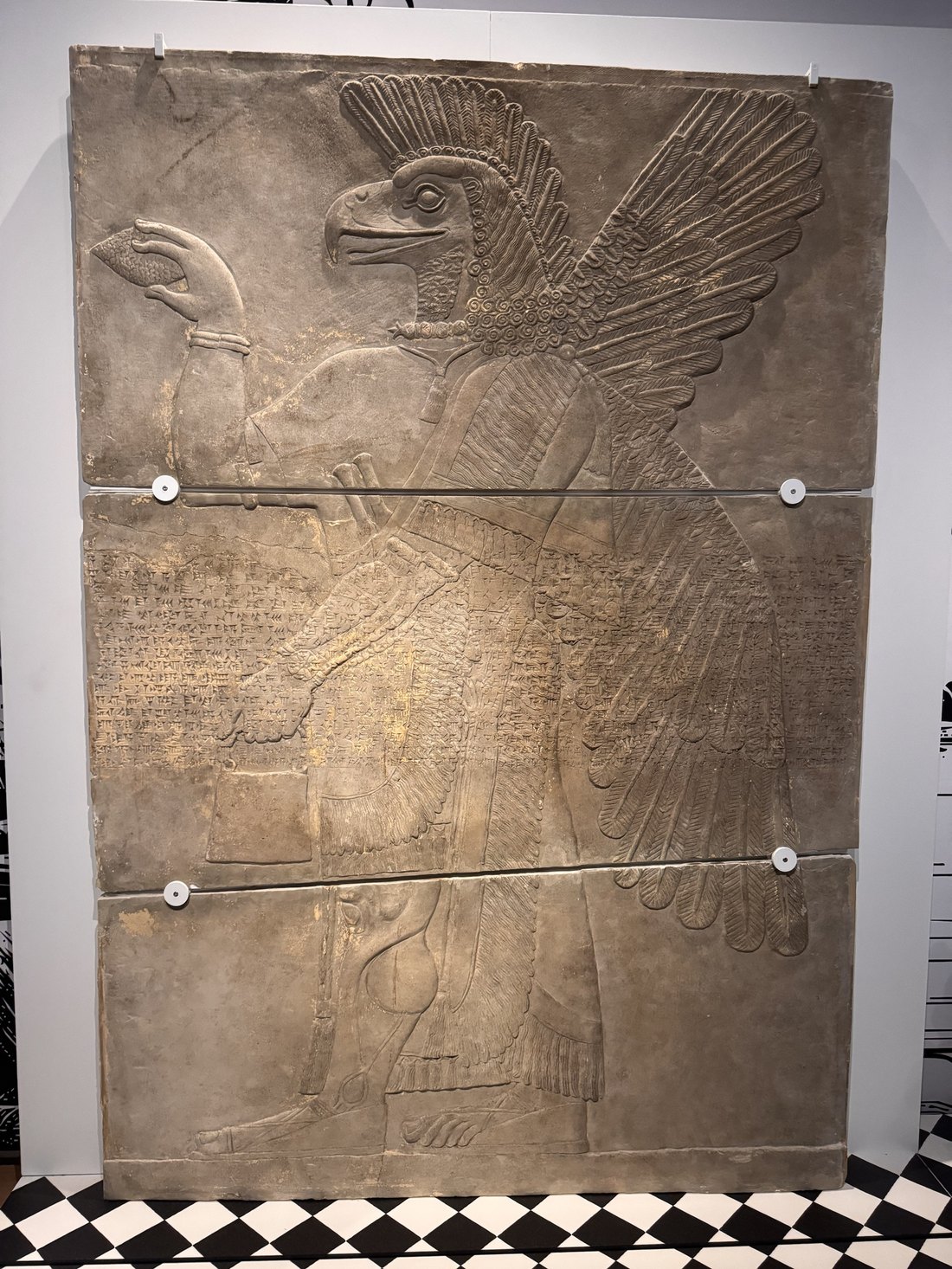
The band of text is, on reliefs of this kind, the Standard Inscription of Ashurnasirpal. The Met describes it as a list of the king’s titles and achievements, repeated across the centre of the reliefs throughout the palace. I cannot read cuneiform and I did not check this panel sign by sign, so I give the general rule, not a reading.
The figure is called an apkallu. The Zurich reference article on the apkallu says the three types of these spirits usually hold a bucket in the lowered hand, the banduddu, and a cone in the raised hand, the mullilu, and suggests the pair stands for purification and blessing. That is the whole action. The rest of this page is about why the same word also names seven sages who lived before the flood.
Who the apkallu are
Apkallu is the Akkadian word for a sage, and it can also mean a kind of priest or exorcist. In the texts the seven sages are semi-divine. A Sumerian temple hymn says they came from Eridu, the first city in the Sumerian King List. The Uruk List of Kings and Sages, a tablet found in 1959 or 1960 in the Seleucid-era temple of Anu at Uruk and dated to about 165 BCE, pairs each of seven kings before the flood with a sage.
| # | Sage | Paired king in the Uruk list | Epithet |
|---|---|---|---|
| 1 | Uanna (also called Adapa) | Ayalu | who finished the plans for heaven and earth |
| 2 | Uannedugga | Alalgar | who was endowed with comprehensive intelligence |
| 3 | Enmedugga | Ameluana | who was allotted a good fate |
| 4 | Enmegalamma | Amegalana | who was born in a house |
| 5 | Enmebulugga | Enmeusumgalana | who grew up on pasture land |
| 6 | An-Enlilda | Dumuzi | the conjurer of the city of Eridu |
| 7 | Utuabzu | Enmeduranki | who ascended to heaven |
Pairs from the Uruk list, epithets from the incantation Bīt mēseri as collated by Conrad and Newing in 1987, both as reported on Wikipedia. Spellings differ between texts and translations, and I aligned the two lists by their order. The Sumerian King List counts eight kings before the flood and Berossus ten; the Uruk list pairs seven.
Berossus, a Babylonian priest writing in Greek around 290 to 278 BCE, gives the best-known version. In the account preserved through Apollodorus, a being called Oannes comes out of the Erythraean Sea with a fish’s body, a human head beneath the fish head and human feet. He teaches writing, crafts, city-building, law and the measuring of land, and returns to the sea at night. Oannes is the Greek form of Uanna. The account has the usual problem of a text that survives in quotations: Apollodorus, Polyhistor and Abydenus disagree on when he appears.
The sages are also in the Epic of Gilgamesh. In N. K. Sanders’s translation, as reproduced in an open textbook I read, the prologue invites the reader to inspect the brickwork of Uruk’s wall and says the seven sages laid its foundations. The Library has the epic, and a different translation will word it differently.
Where the flood comes in
In the texts the flood is the cut. The Uruk list has a note on the Deluge between the seven sages before it and the later ones. The scholarly article in the Zurich Iconography of Deities and Demons project says the flood divides immortal sages from mortal ones, and that Ziusudra, also called Utnapishtim and Atrahasis, was probably the last sage before it. In Berossus, Xisuthros is the king at the time of the flood, in a list of ten. After the flood the sages are human, and are usually called ummânu rather than apkallu. The Uruk list continues that line down to Nebuchadnezzar and Esarhaddon, whose sage Aba-Enlil-dari it says “the Arameans call Ahiqar”.
Then there is a darker thread. In the Epic of Erra, which the same article dates probably to the eighth century BCE, Marduk banishes the sages to the Apsu, the watery deep, and forbids them to return. Wikipedia, summarising Kvanvig’s 2011 study, places this after the flood, says Erra later persuades Marduk to recall them, and says the damaged text seems to end with human sages assigned to cleanse Marduk’s shrine. Some ritual material also says that certain sages angered the gods. The flood story itself, and how it relates to Genesis, is in the Bible thread, and the claim of a flood layer at Ur is in the Ur dossier.
What the figures on the walls are doing
The palace reliefs are not a picture of the sages teaching. At Nimrud the apkallu stand at doorways and room corners, where people believed evil spirits lurked, according to World History Encyclopedia, which also says Room F next to the throne room was lined with eagle-headed apkallu and the sacred tree, and that the king’s private South Suite has almost none. The same scholarly article says clay figurines of these types were buried in groups under the foundations at Assur, Nimrud and Nineveh, and that ritual texts describe them as protective figures. In the Assyrian tradition they are guardians, and they purify.
The Zurich article separates three types: winged and human-figured, fish-cloaked, and bird-of-prey-headed. It matches the fish-cloaked one to Berossus’s Oannes, and says the three share the bucket and cone. The eagle-headed spirit in my photo is therefore not Oannes. The article says all three types first appear in the late second millennium BCE, with early dated examples on the stela of Tukulti-Ninurta II (890 to 884 BCE) and in Ashurnasirpal’s palace.
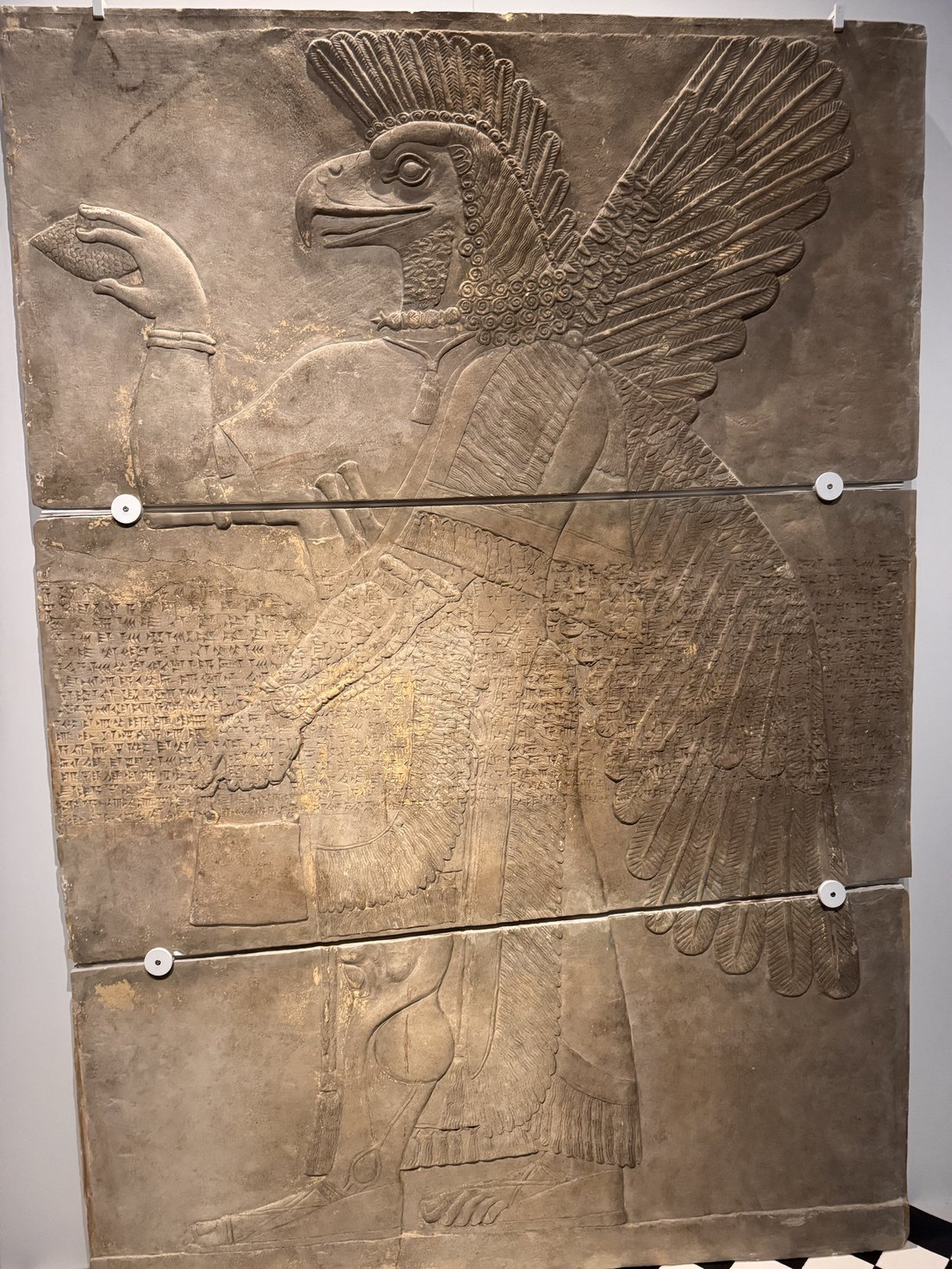
That gives the real puzzle of this thread. The texts that put the sages before the flood are late: Berossus c. 290 to 278 BCE, the Uruk list c. 165 BCE, Erra probably the eighth century BCE. The Zurich article points to a large gap between a textual tradition that places the sages in early antiquity and the much later iconography. The name links them. Whether the people who carved the palace walls had the pre-flood sages in mind, or the guardian spirits of ritual, is not something the reliefs themselves say.
The claims and the replies
| Claim | Who | The reply, and where it comes from | Status |
|---|---|---|---|
| The bucket is a “handbag”, a device carried by the gods | Online collages that pair this figure with carvings at Göbekli Tepe and in the Olmec world | Assyrian ritual texts name the objects: the banduddu, a bucket probably for water, and the mullilu, a purifier, probably a cone used to sprinkle it. F. A. M. Wiggermann matched the words to the reliefs in 1992, according to an auction-house blog; the Zurich article gives the bucket and cone as purification. | Contradicted by the texts |
| The apkallu were non-human teachers, even visitors from space | Retellings in the ancient-astronaut genre | The texts do call them semi-divine and from Eridu, the water or the Apsu, and Berossus has Oannes teach the arts. I found nothing that places them as visitors from the sky. One sage, Utuabzu, is called “who ascended to heaven” in the collation reported by Wikipedia, which is one line about one sage. | The teaching is in the texts; the extraterrestrial reading is not |
| The reliefs show the sages teaching humanity | Popular captions | The figures stand at doors and beside a sacred tree and carry a bucket and a cone. The teaching comes from Berossus and the lists, not from the reliefs. | Not what the reliefs show |
| The Watchers of the Book of Enoch grew out of the apkallu | Amar Annus, Journal for the Study of the Pseudepigrapha 19(4), 2010 | The abstract argues that the Watcher stories and their giant sons are reversed forms of Mesopotamian traditions about the pre-flood sages, some of which already saw the sages as dangerous. I read the abstract, not the paper. | A published scholarly proposal |
The Watchers and the giants are in the giants thread. The auction-house blog is commercial and ends by promoting a lot in its own sale; I used it only for the reference to Wiggermann.
What if the flood in these texts marks a real break in what people remembered, not only a story event? The sages stand on the far side of it, and everything after is human and mortal.
I am speculating about why the tradition is built this way, not about who the sages were. Why it is worth asking: the Uruk list and the Zurich article both put the line at the flood. What supports it: a break of that kind would explain why knowledge is credited to figures who cannot be dated. What speaks against it: the sources I found are all late, the lists look like scribal constructions that pair sages with kings down to Esarhaddon, and I found no evidence from the ground for an event. What would separate the readings: an earlier source, say from the third millennium BCE, that already has the seven sages and the same break. What stays unknown: how old the idea of seven sages is.
What is still open
How old is the tradition of the seven sages?
The sources I read are all first millennium BCE or later: Erra probably the eighth century, Berossus around 290 to 278, the Uruk list about 165. The Zurich article puts the earliest iconography in the late second millennium. I found no earlier text, so the tradition may be older than its records, but that is a guess.
Did the Watchers come from the apkallu?
Annus proposed it in 2010, and I read only the abstract. The giants thread dates the Book of the Watchers to the 4th or 3rd century BCE, so the proposal has a plausible time window, but I did not find or read the replies, so I cannot say how widely it is accepted.
What is the cone?
The museum text I read says the cone is a sprinkler shaped like the male flower sheath of the date palm. World History Encyclopedia calls it a pine cone. The Zurich article says only that it is a cone, the mullilu, linked with purification. The sources differ, and the cone in my photos shows a scaled surface, which does not settle the question.
Sources
- Iconography of Deities and Demons (IDD), University of Zurich, prepublication article “Apkallū”: the word, the three types, the bucket and cone, the foundation figurines, the flood as divider, the Epic of Erra, the gap between texts and iconography. A scholarly reference work. I did not see the author’s name in what I read.
- Wikipedia, Uanna: the Uruk List of Kings and Sages, the seven names and epithets, Berossus’s Oannes and its variants, Erra and Kvanvig (2011). Secondary; it cites Borger 1974, Lenzi 2008, Conrad and Newing 1987, Mayer Burstein 1978 and Cory 1828, none of which I have read.
- Metropolitan Museum of Art, “Nimrud” (essay): Ashurnasirpal II 883 to 859 BCE, the Northwest Palace, the Standard Inscription, the protective figures. The Met’s page does not give the excavation dates.
- Bowdoin College Museum of Art, Relief panel with winged, eagle-headed spirits: the bucket, the cone as a date-palm flower sheath, the apkallu as protective spirits. A museum object page.
- World History Encyclopedia, “Wall Reliefs: Apkallus of the North-West Palace at Nimrud”: where the figures stood, Room F, the pine cone and bucket. It gives Ashurnasirpal’s reign as 884 to 869 BCE, which differs from the Met; I used the Met’s dates.
- Livius.org, Apkallū (Seven Sages): Uanna, Berossus and the sages as teachers, the mention in Gilgamesh. It names only one sage and gives no flood story.
- Annus, A., “On the Origin of Watchers: A Comparative Study of the Antediluvian Wisdom in Mesopotamian and Jewish Traditions”, Journal for the Study of the Pseudepigrapha 19(4), 2010, 277 to 320, abstract via the ORION bibliography. Abstract only.
- The Epic of Gilgamesh, translated by N. K. Sanders, as reproduced in an open textbook: the seven sages and the foundations of Uruk’s wall. I read the first 100,000 characters of the page, which included the prologue.
- TimeLine Auctions, “The handbag that wasn’t”, 3 August 2026. A commercial auction-house blog, unsigned; used only to describe the “handbag” collages and to cite Wiggermann 1992, whom I have not read.
A thread, not a place. Page opened and last reviewed 1 November 2026. Written from a scholarly reference article, museum pages and secondary sources; I have not read the cuneiform texts, Berossus or the papers cited. The photos are my own, taken in the Rijksmuseum van Oudheden in Leiden; on 2 November 2026 I added the museum’s name as the photographer told it, without checking the museum’s record. If something here is wrong, tell me and it gets corrected on the page with a note saying what changed.