Ur
Near Nasiriyah, southern Iraq · not visited
The popular story says the river moved away and the city died. The sources give several causes and several dates, and the oldest account of Ur's fall blames an assembly of gods.
- Latitude
- 30.9617° N
- Longitude
- 46.1051° E
- Ziggurat begun
- 21st century BCE
- Last occupied
- 5th to 4th century BCE, sources differ
- Open questions
- 3 logged
The short version that is going around
A short video making the rounds tells it like this. For thousands of years Ur was a city of water. Silt pushed the coast of the Persian Gulf south, the Euphrates wandered away, and without water the city could not farm, fish or trade. By about the 4th century BCE it was empty, and the desert buried it for two thousand years.
It is a clean story and parts of it hold. But it takes one possible cause, states it as the cause, and picks one of several published dates. This dossier checks what the sources support. It also covers something the short version leaves out: the oldest surviving account of Ur's end blames neither the river nor the sea.
What is actually there
The site is Tell al-Muqayyar, near Nasiriyah in southern Iraq: a mound roughly 1,200 by 800 metres and about 20 metres high. It is part of the Ahwar of Southern Iraq, which UNESCO inscribed in July 2016. The city's patron was the moon god Nanna, known as Sin in Akkadian.
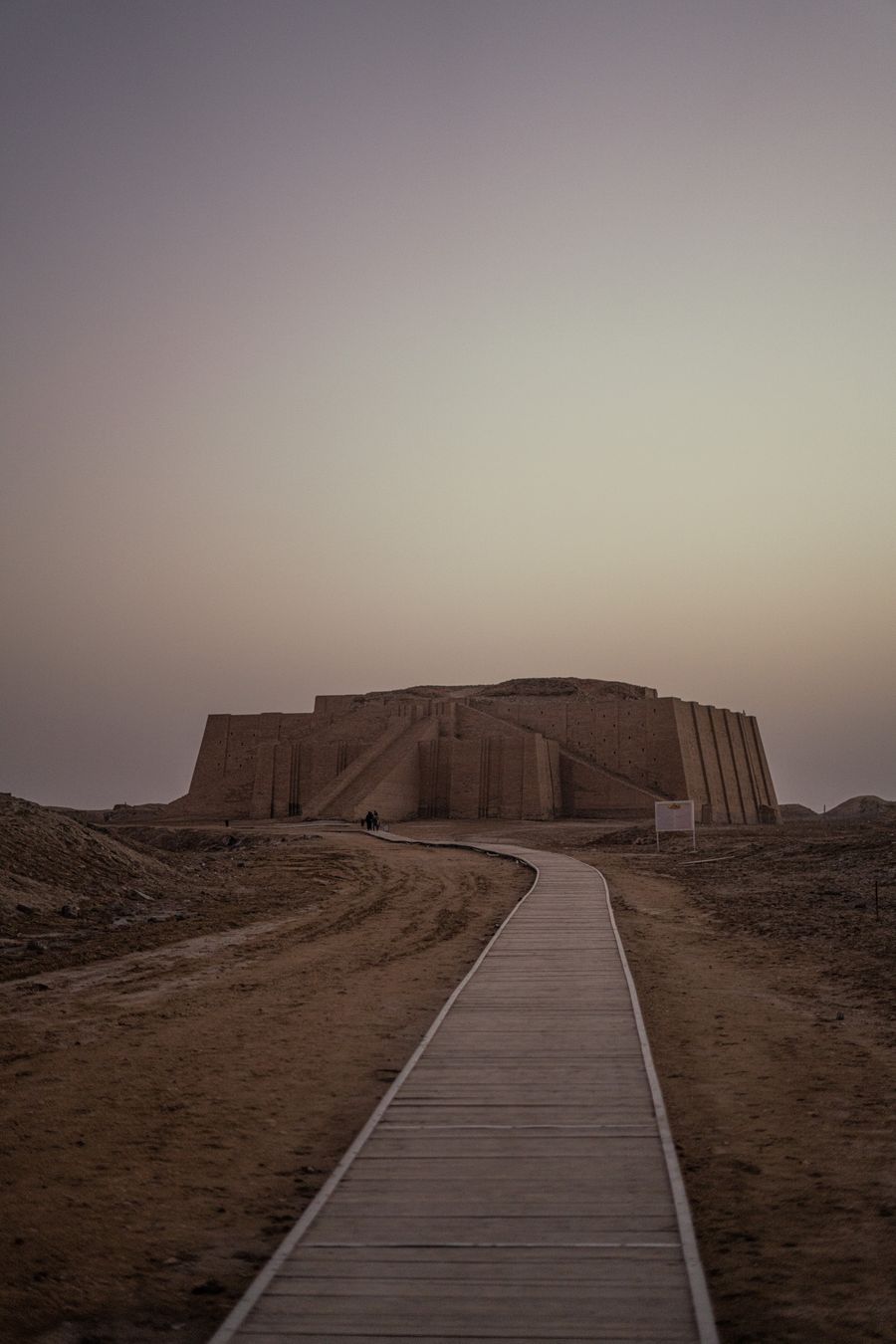
At its centre stands the Great Ziggurat, a stepped temple tower. Ur-Nammu began it in the 21st century BCE and his son Shulgi, who reigned for forty-eight years and proclaimed himself a god, finished it. The base measures about 64 by 45 metres. A height of over 30 metres is often quoted, but it is a reconstruction: only the foundations of the Sumerian ziggurat survive.
Much of what you see is later. In the 6th century BCE the Babylonian king Nabonidus restored the tower, finding little left but its last stage and nothing to show what the original looked like, and rebuilt it in seven stages. The lowest-level facade and the monumental staircase were rebuilt under Saddam Hussein. In the 1991 Gulf War that reconstruction was hit by small-arms fire, and the walls carry over four hundred bullet holes.
Sir Leonard Woolley excavated Ur from 1922 to 1934 for the University of Pennsylvania Museum and the British Museum, and found the Royal Cemetery. He also claimed to have found evidence of the biblical Flood. According to World History Encyclopedia, the notes of his assistant Max Mallowan show that the flood deposit did not support a worldwide deluge. I have not seen those notes myself. For the Flood more broadly, see the Durupınar dossier.
The sky here
Nanna was the moon god, the ziggurat was his house, and the tower rose toward the sky he ruled. I could not find a published orientation or azimuth for the ziggurat that I can verify, so this dossier gives no figure instead of a guess. If you know a survey, tell me and it goes in with the source.
Two endings, and who decided the first
Ur ended twice. The first time was around 2000 BCE, when the Third Dynasty of Ur fell. Wikipedia gives its last king, Ibbi-Sin, a reign of about 2028 to 2004 BCE and has the Elamites ending the dynasty. The city itself survived and was rebuilt, and it was still being restored by Nabonidus some fifteen hundred years later.
What the people of Ur wrote about that first ending is the Lament for Urim, a Sumerian poem composed around the fall. I did not check the dates of the surviving manuscripts. A second, longer composition, the Lament for Sumer and Urim, also exists; I read only the first. In the translation published by the Electronic Text Corpus of Sumerian Literature, the goddess Ningal, Nanna's wife, describes how it was decided: “the Anuna had seated themselves to ratify decisions”, and “They gave instructions that my city should be utterly destroyed.” She pleads with An and Enlil and fails. “An is not one to change his command, and Enlil does not alter what he has uttered.” The poem closes with a prayer that Nanna's restored city may be resplendent before him. (The quotations come from around lines 151 to 168 of that translation, which I read through a text-fetching tool, not in the Sumerian.)
“Anuna” is the spelling that translation uses for the Anunnaki. In the earliest Sumerian texts they are a group of gods, descendants of An (the sky god, Anu in Akkadian) and Ki (earth), whose main role was to decree the fates of humanity. The oldest known uses of the name come from inscriptions of Gudea (c. 2144 to 2124 BCE) and from the Third Dynasty of Ur itself. From the Middle Babylonian period they are increasingly underworld gods, and in Inanna's Descent seven of them act as the judges who condemn her. In the sources they are an assembly with a function: they ratify decisions about fate.
The claim that the Anunnaki were astronauts
Zecharia Sitchin argued in The Twelfth Planet (1976) that the Anunnaki were extraterrestrials from a planet called Nibiru, who came to Earth to mine gold and created humans as labour. Wikipedia describes his work as pseudoarchaeology, universally rejected by mainstream historians, and says critics find he quoted texts out of context, truncated quotations and mistranslated words. I have not checked his translations line by line.
What I can say is what the passages above contain: an assembly of gods ratifying a decision about a city. In the lines I read there are no visitors, no planet and no mining. I did not read the whole poem looking for them. The ETCSL text is free online, so anyone can read the passage and weigh the claim against it.
What is still open
Why was Ur abandoned, and when?
Wikipedia dates the decline from the Persian conquest of Babylonia, about 530 BCE, and has Ur uninhabited by the early 5th century BCE, “perhaps owing to drought, changing river patterns, and the silting of the outlet to the Persian Gulf”. World History Encyclopedia says about 450 BCE and adds overuse of the land. Britannica's outline of the city's history lists a last phase running to the 4th century BCE; I could read the headings only. The short video says the 4th century. That is a spread of a century or more, and it matters, because the date decides which events can count as causes.
I found no dated evidence from Ur itself that settles between drought, a moved river and a silted outlet, and each source offers them as possibilities. A study of Abu Tbeirah, a Sumerian site in the same area, shows what such evidence looks like: a river channel cut off by a flood, dated to roughly 2600 to 2300 BCE, and linked by the authors to reduced sediment supply from climate change, though they do not rule out human intervention. That is a different site and a much earlier event. It shows that channels in this landscape did shift, not why Ur was left. I read the abstract and a summary of that paper.
How close was the sea?
The picture of Ur as a seaport with the Gulf retreating from its walls is the classic one, and the same Abu Tbeirah study complicates it. It reports that about 6,000 years ago the Gulf shoreline lay roughly 250 to 260 kilometres inland of today's, that in the third millennium BCE Abu Tbeirah sat in a marshy delta about 30 kilometres inland of the coast, and that the Gulf reached roughly its present form only around 1000 CE. The paper does not address Ur directly.
Two things follow. Ur was a delta and marsh city whose connection to open water ran through channels, not a harbour on an open coast. And the coast kept moving for some fifteen hundred years after Ur emptied, so the retreat of the sea is not by itself a date for anything. Where the water at Ur's gates was, in each century, is not something I have seen mapped.
What did the ziggurat look like when it was new?
Only the foundations of the Sumerian ziggurat survive. Nabonidus found little left and rebuilt it in seven stages, and the staircase and facade visitors see are twentieth-century reconstruction. So the stepped tower in photographs shows a Babylonian king's idea of the monument, finished by a modern one. The height and the number of stages of Ur-Nammu's original are estimates.
What if the gods' assembly in the Lament is how a culture described a failure it could not trace to one cause? Modern accounts also reach for a single agent: the river, the sea, the climate. The oldest account reaches for An and Enlil.
I am speculating about a way of explaining, not about the facts of Ur's fall. Why it is worth asking: because both the ancient and the popular story compress a messy event into one decision or one cause. What supports it: the modern record lists several causes at once, drought, rivers, silting, overuse and conquest. What speaks against it: the Lament is a literary mourning poem that ends in a prayer for restoration. It does not claim to be a cause analysis, and nothing in the lines I read points to environmental stress. I also read a translation, not the Sumerian. What would tell the readings apart: a dated palaeoenvironmental record from the Ur area covering the end of the Third Dynasty and the Achaemenid period, set against the Lament's wording and against other Mesopotamian laments. What stays unknown: whether anyone at the time connected the city's fate to anything but the will of the gods, and what “decision” meant to the people who wrote it.
Sources
- Wikipedia, Ur: dimensions of the mound, patron god, the dynasty dates, and the causes it lists for the abandonment. Its own date of 1940 BCE for the fall of the dynasty conflicts with its dynasty table, so this page says about 2000 BCE. Ziggurat of Ur: Ur-Nammu, Shulgi, dimensions, Nabonidus, the Saddam-era facade and staircase, war damage. Ahwar of Southern Iraq: the 2016 inscription. Encyclopedia pages, secondary sources; I have not read Woolley's excavation reports.
- Electronic Text Corpus of Sumerian Literature (ETCSL), University of Oxford, “The lament for Urim”, translation. Read through a text-fetching tool, in part; line numbers approximate. Wikipedia, Lament for Ur, for the composition around the fall of the dynasty.
- Wikipedia, Anunnaki: their role in early Sumerian texts, the Gudea and Ur III attestations, Inanna's Descent, and Sitchin's The Twelfth Planet (1976) with the scholarly response. I did not read Sitchin.
- World History Encyclopedia, “Ur”: abandonment about 450 BCE, Woolley's flood claim and Mallowan's notes. A popular source. Britannica, “Ur”: section headings only; the page text was not readable.
- “The paleoenvironment and depositional context of the Sumerian site of Abu Tbeirah, Nasiriyah, southern Mesopotamia, Iraq”, Quaternary Research, 2022, Cambridge Core. I read the abstract and a summary only, and I have not recorded the authors.
- Pexels, photo 14111676 by khezez, for the photograph. Pexels says its photos are free to use and that credit is not required. I could not open the image itself, so its subject follows the uploader’s description. The page tags the location only as “Iraq”, and a related photo by the same uploader is tagged Amarah, so check the picture by eye.
Not visited in person. Written from published sources. Page opened and last reviewed 14 October 2026. The chart is an original illustration. If something here is wrong, tell me and it gets corrected on the page with a note saying what changed.