Stonehenge
England · not visited
A circle of stones aligned on the solstice, joined like carpentry, hauled from Wiltshire, Wales and probably Scotland, and not one word from its builders about why. The alignment is real. “Built on the longest day” is not what the dates show.
- Latitude
- 51.1789° N
- Longitude
- 1.8261° W
- Built
- c. 3000 to 1600 BCE
- Stone phase
- c. 2500 BCE
- Open questions
- 4 logged
Fifteen centuries, not one day
Stonehenge is not one monument. English Heritage dates the first major event to about 3000 BCE: a circular ditch with banks inside and outside, roughly 100 metres across, with two entrances, and inside the bank a ring of 56 pits known as the Aubrey Holes. Cremated remains were put into those pits, about 64 cremations found so far, and perhaps as many as 150 people originally. For several hundred years the site was, among other things, a cemetery.
The stones come later. Around 2500 BCE the central settings went up: the big sarsen circle with its lintels, five freestanding trilithons in a horseshoe, and smaller bluestones between them. Radiocarbon dates put the sarsen phase somewhere between 2600 and 2400 BCE. Two or three centuries later the bluestones were rearranged and the Avenue, a pair of banks and ditches running about three kilometres to the River Avon, was added. The last known digging, the Y and Z holes, dates to 1800 to 1500 BCE.
Nobody laid the first stone on a solstice and finished by the next one. The monument was altered for about fifteen centuries.
That matters for your first claim, which comes up in almost every retelling: that Stonehenge was built on the longest and shortest day of the year. The alignment is real. “Built on” in the sense of a single day is not what the dating shows. The better statement is that people kept building and rebuilding on one axis.
The axis
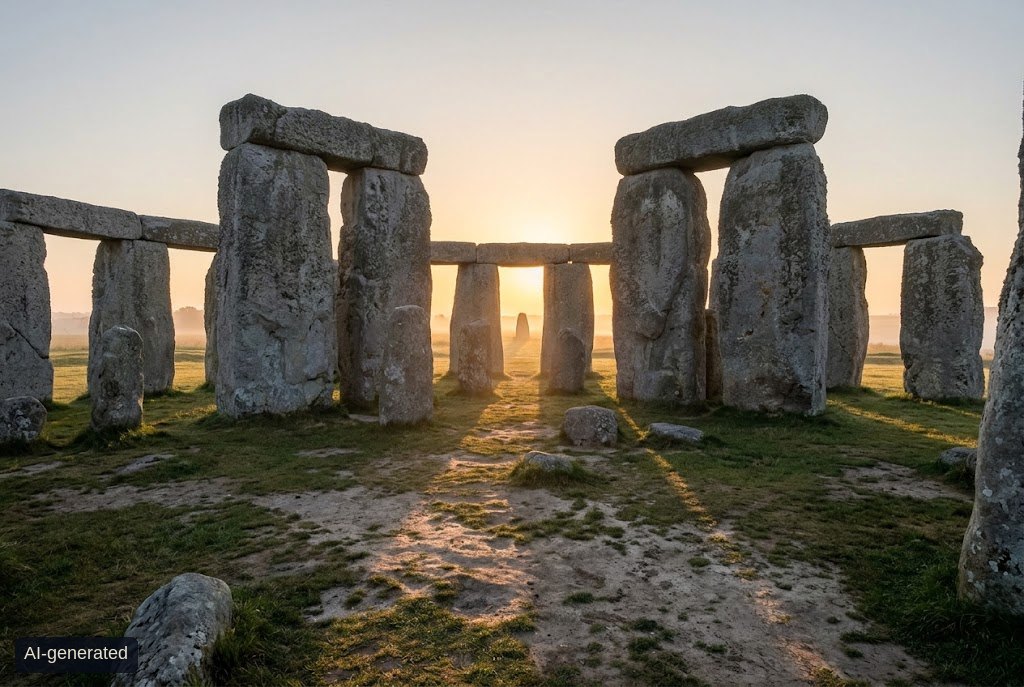
The monument faces the northeast. Stand inside the circle at midsummer and the sun rises near the Heel Stone, a rough 30-tonne sarsen standing outside the entrance. Turn the whole thing around and the same line points at the midwinter sunset, down the Avenue. William Stukeley noticed the midsummer line in 1720, and it has been argued over ever since.
Three details keep the claim honest. The Heel Stone does not mark the sunrise exactly, and the shift in the Earth’s tilt since construction does not account for the gap. Second, the Wikipedia article on archaeoastronomy at Stonehenge states that the alignment “could be coincidental”. Third, against that: a laser survey of the stones found that the stones facing northeast were the most carefully worked, and Clive Ruggles, emeritus professor of archaeoastronomy at Leicester, said it shows “unequivocally” that the formal approach was always intended to be from the northeast. The builders cared about that direction.
Winter, not summer, may be the headline. Susan Greaney of English Heritage wrote for the British Museum in 2022 that midwinter was probably the most important focus: the midwinter sunset is what faces you as you walk up the Avenue and enter. Two miles away at Durrington Walls, a settlement of the same period, pig bones in the pits were mostly from animals killed at about nine months old, which if they were born in spring means slaughter around midwinter. Mike Parker Pearson said in 2005 that there was no evidence anyone was in the landscape in summer, and later that it was reasonable to assume midsummer was also marked. The midsummer crowds are modern: some 20,000 people came in 2005.
The craftsmanship
This part of your list is the best supported. The sarsen uprights average about 25 tonnes and the Heel Stone is about 30. The trilithons are given as up to about 50 tonnes each. The bluestones are smaller, 2 to 5 tonnes, but they come a long way.
Where the stones come from: a 2020 study in Science Advances by David Nash and colleagues matched 50 of the 52 sarsens still at Stonehenge to one chemical signature, and traced the most probable source to West Woods, about 25 kilometres north. The bluestones come from the Preseli Hills in south-west Wales, roughly 230 kilometres away. The six-tonne Altar Stone was long assumed to be Welsh as well. A 2024 study from Curtin University put it in the Orcadian Basin in north-east Scotland, and a 2026 paper (on the Research list on the front page) pins it to Caithness, about 700 kilometres away.
Then there is the working. Large and small hammerstones of sarsen and flint were used to flake and then smooth the surfaces, and waste and broken hammerstones have been found in the field north of the monument. The uprights are tapered so that they widen towards the top. The lintels are curved to follow the circle. Upright and lintel are joined by mortise-and-tenon joints, and the lintels are joined to each other by tongue-and-groove joints, which English Heritage notes are usually found only in woodworking. The final shaping of the tenons seems to have been done after the stones were up, to fit the mortises.
It is also uneven. The laser survey found that the outer sarsens visible from the northeast were completely pick-dressed, with the natural crust removed, and that the inner faces of the central trilithons were finely dressed. The outer faces of surviving uprights in the south-west segment were not. The builders worked hardest where the monument was meant to be seen from.
One caveat. What is attested is the hammerstones, the waste, the laser-scanned faces and the stone chemistry. How the stones were hauled and raised is a reconstruction. English Heritage’s own text says the stones were “probably” raised with plant-fibre ropes and a wooden A-frame, that the lintels were “probably” lifted on timber platforms, and that building took hundreds of people. It gives no time span.
Your claims, one by one
| Claim | Where it comes from | What the evidence says | Status |
|---|---|---|---|
| Built on the longest and the shortest day | Retellings of the solstice alignment; Stukeley’s 1720 survey is the oldest | The axis points to the midsummer sunrise and the midwinter sunset, and the laser survey suggests the northeast approach was deliberate. The monument took about fifteen centuries to build, and the Heel Stone is not exactly on the sunrise | Partly right |
| The purpose is unclear | English Heritage, British Museum | There is no written source. The readings are cemetery, healing site, domain of the ancestors, or a place of unity. They overlap, and a long-lived site can have had several | Supported |
| Remarkably skilfully made | Archaeologists generally; the English Heritage building page | Mortise-and-tenon and tongue-and-groove joints in stone, tapered uprights, curved lintels, and dressing that is finest on the northeast faces. How the stones were raised is reconstruction | Supported |
| Aligned on stars | Broome (1864, Sirius, 977 BCE); Lockyer (1680 BCE); Petrie (730 CE) | Lockyer used a wrong azimuth for the Avenue, aligning it on a modern trig point. Petrie’s survey used stones leaning heavily. I found no accepted stellar alignment | Not supported |
| Aligned on the Moon, and an eclipse predictor | Hawkins (1963), Newham (1966), Hoyle | Hawkins counted 13 solar and 11 lunar correlations; Atkinson replied that pits could be natural and that errors up to 2 degrees were allowed, putting the odds close to even rather than one in a million. Newham’s rectangle needs two damaged stones. Thom’s key site turned out to be a rubbish dump | Not verified |
| A 365.25-day calendar in the stones | Darvill, Antiquity, 2022 | Magli and Belmonte answer that the number 12 does not appear in the monument, that near the solstice the sunrise point barely moves from day to day, so counting days would need a precision of a few minutes of arc, and that the Egyptian comparison is weak. They call it an alleged calendar | Not verified |
Status as of 20 October 2026. “Not verified” means I found no source that settles it, not that the claim is false. Most of this comes from English Heritage, the British Museum blog and Wikipedia, plus two papers I read only in summary; the Darvill paper itself I did not read.
What if the axis is less an instrument than a direction to face? Not a clock for counting days, but a line along which people agreed to turn up, at the two moments in the year when the sun stops moving along the horizon. The monument would then be the fixed part of an event: a procession, a feast, a burial, repeated until the line was worn into the ground.
Why it is worth asking: it fits the winter feasting at Durrington Walls, the midwinter sunset facing the visitor at the entrance, and the Avenue running between the monument and the river. What supports it: Durrington’s timber circle faces the midwinter sunrise and its avenue the midsummer sunset, according to Wikipedia’s account, and the laser survey says the formal approach was always from the northeast. Parker Pearson links Stonehenge, the domain of the dead, with Durrington, the domain of the living, along the Avon. What speaks against it: that link is an interpretation, not a finding. The Heel Stone is not exactly on the sunrise, and the Wikipedia article that records the alignment also says it “could be coincidental”. What would tell the readings apart: more dated feasting and burial events at the exact times of year, and a better count of how many people visited in which season. What stays unknown is what anyone thought was happening when the sun came through.
What is still open
Why was it built?
Nobody wrote it down. The main readings are an enclosed cremation cemetery, which the early ditch and the Aubrey Holes support; a place of healing, argued by Geoffrey Wainwright and Timothy Darvill, partly from burials with signs of trauma and from the bluestones, which ring when struck; and a place for the ancestors, tied to Durrington Walls by Parker Pearson. These are not exclusive, and a monument in use for fifteen hundred years can have meant different things at different times. I read the 2022 British Museum blog as suggesting the original purpose was probably already forgotten by about 1500 BCE.
What were the builders watching for in the sky?
The solstice axis is the one thing nearly everyone accepts. Beyond it, nothing is settled. A lunar rectangle in the four Station Stones (Newham, 1966) only works within about 50 kilometres of this latitude, and two of the four stones are damaged. John Aubrey himself never connected the monument to the stars, and the star dates proposed since have been undone one by one. A study of the Aubrey Holes timed for the lunar standstill, which the Royal Society blog dates to January 2025, was announced there. I did not find its result. The question is whether anything beyond the sun was meant at all.
How did they move and raise it, and where did the bluestones start?
The sarsen source is well supported, and so are the Welsh bluestone quarries. The route and the method are not. For the Altar Stone, the 2026 paper concludes that people moved it for at least part of the way, because ice could not have carried it all, and the exact source is not pinned down. At Waun Mawn in Wales a 110-metre circle has the same diameter as Stonehenge’s original bluestone circle, which suggested a dismantled Welsh monument. A 2021 study found no more than 13 stones were removed in antiquity. Whether the bluestones were first a circle somewhere else is unsettled.
Who were the people in the Aubrey Holes?
The remains are roughly equal male and female and include children. A 2018 strontium study suggested that many of them came from near the Welsh bluestone source. If that holds, the monument was tied to a place far away by people as well as by stone. I have not read the study, so I cannot say how many individuals it covered. Whether these are founders, the high-ranking, a few families or a random sample is open.
Sources
- English Heritage, Stonehenge history and Building Stonehenge. Phases, dressing, joinery and the “probably” of the raising methods.
- Greaney, S., “Here comes the sun! Stonehenge and the summer solstice”, British Museum blog, 15 June 2022. Midwinter focus, Durrington Walls pigs, the laser survey.
- Nash, D.J. et al., “Origins of the sarsen megaliths at Stonehenge”, Science Advances 6 (31), 2020. Open access. I read the summary and method notes.
- Wikipedia, Stonehenge and Archaeoastronomy and Stonehenge. Secondary: used for the distances, the star and Moon history, and the Parker Pearson quotes. The Newham, Hawkins and Atkinson details come from the second article, not the original papers.
- Magli, G. and Belmonte, J.A., “Archaeoastronomy and the alleged ‘Stonehenge calendar’”, preprint. A response to Darvill, Antiquity, 2022. I did not read Darvill’s paper.
- Clarke, Veness et al., Journal of Quaternary Science, 2026, on the Altar Stone: doi:10.1002/jqs.70080. Read via the Curtin University release, not the paper. The 2024 Nature paper on the Orcadian Basin I know through secondary reports.
- Royal Society, “Sun and moon stones”, blog, 2024. Used for the lunar standstill study and for Stukeley and Lockyer.
- Laser survey of the stones: the trade press summary, with the Ruggles quote. The underlying report is Historic England’s laser scan analysis, which I did not read.
- UNESCO World Heritage listing, Stonehenge, Avebury and Associated Sites, inscribed 1986.
Not visited in person. Written from published sources. Last reviewed 20 October 2026.