Luxor Temple
Türkiye · not yet visited, written from published excavation reports
A temple built for a festival, expanded by kings who didn't quite agree on which direction it should face, and never actually closed.
- Latitude
- 25.6997° N
- Longitude
- 32.6396° E
- Core built
- c. 1390 BCE, Amenhotep III
- Still in use
- Abu al-Haggag Mosque, active
- Open questions
- 4 logged
What is actually there
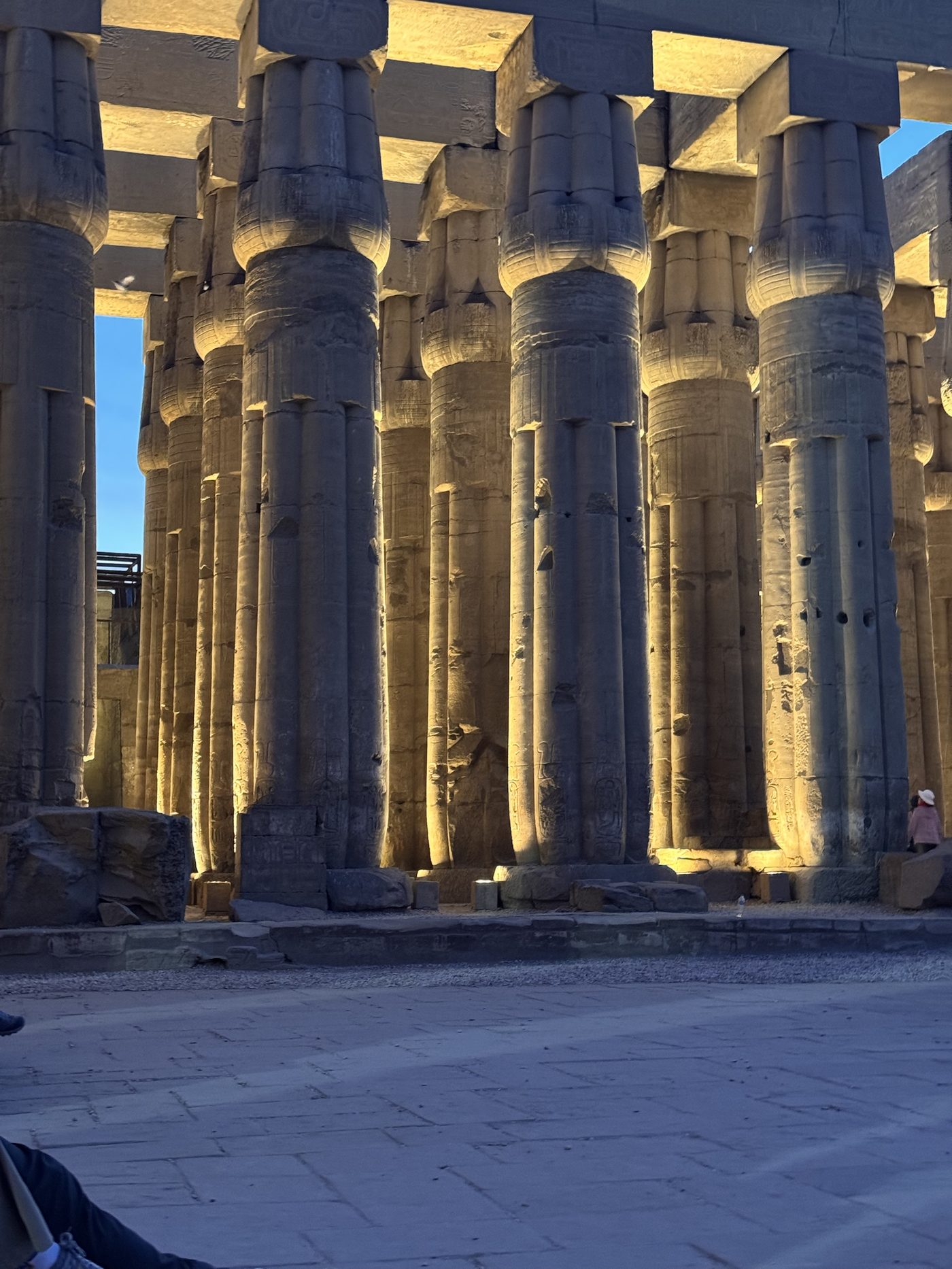
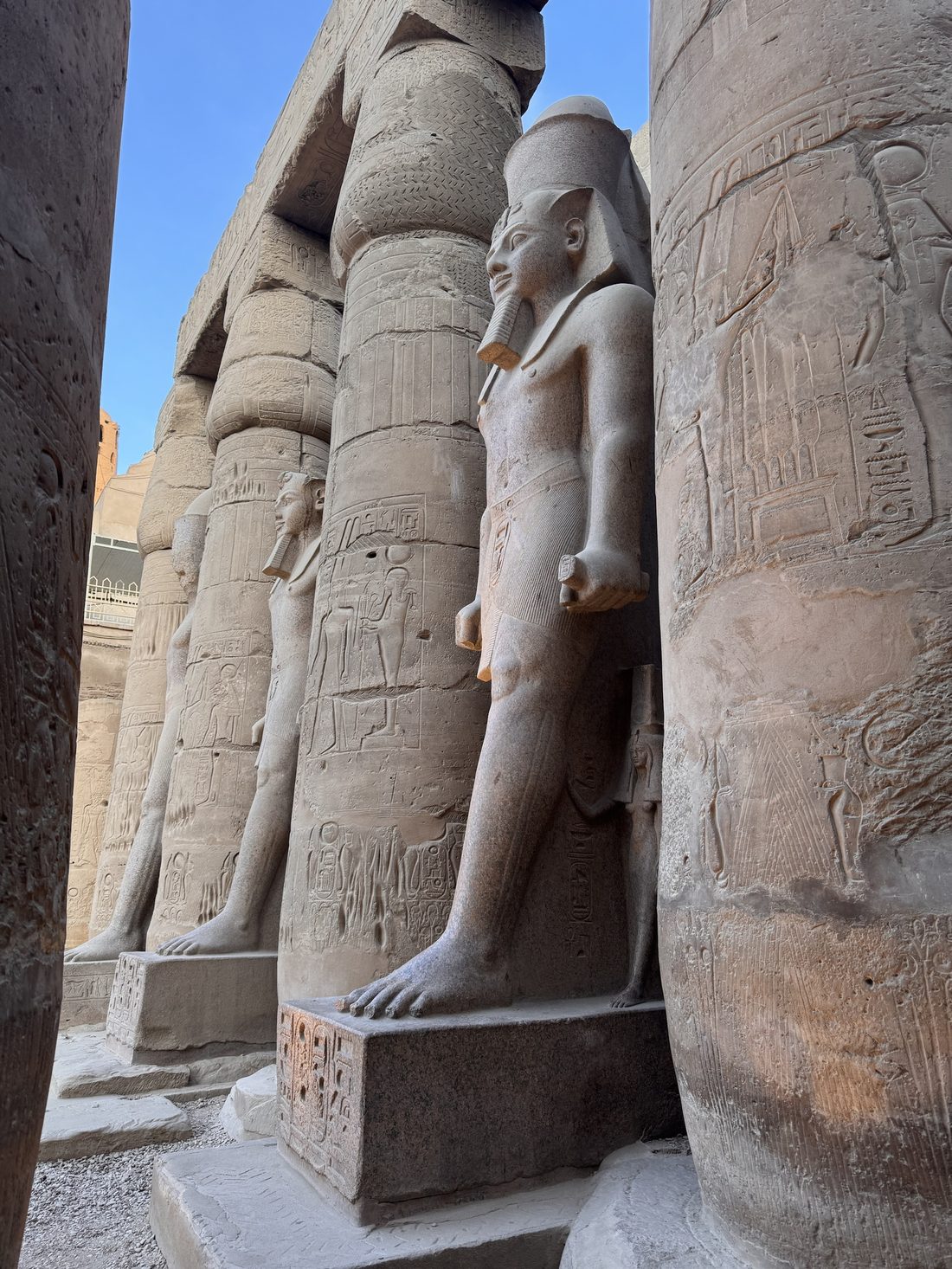
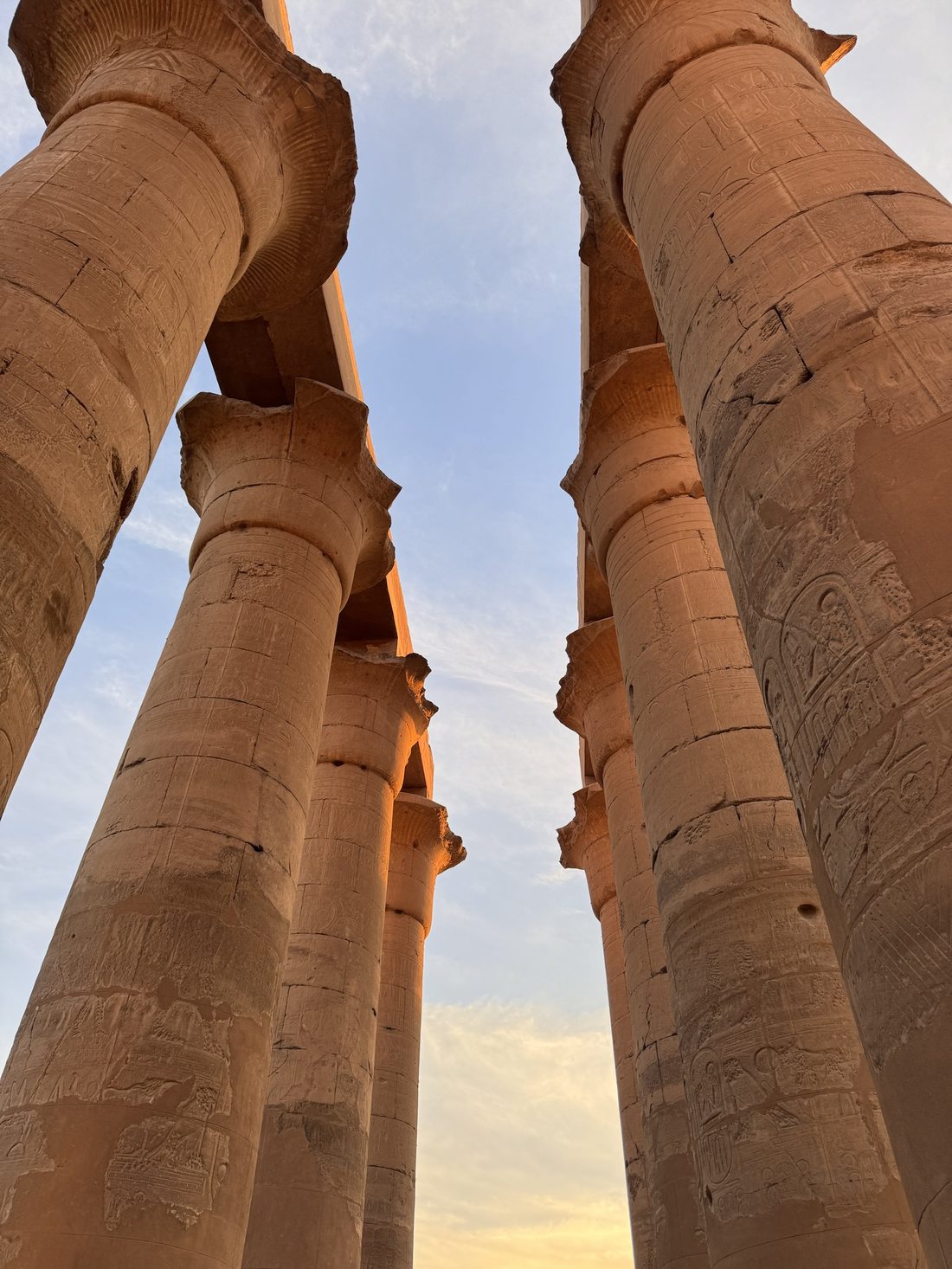
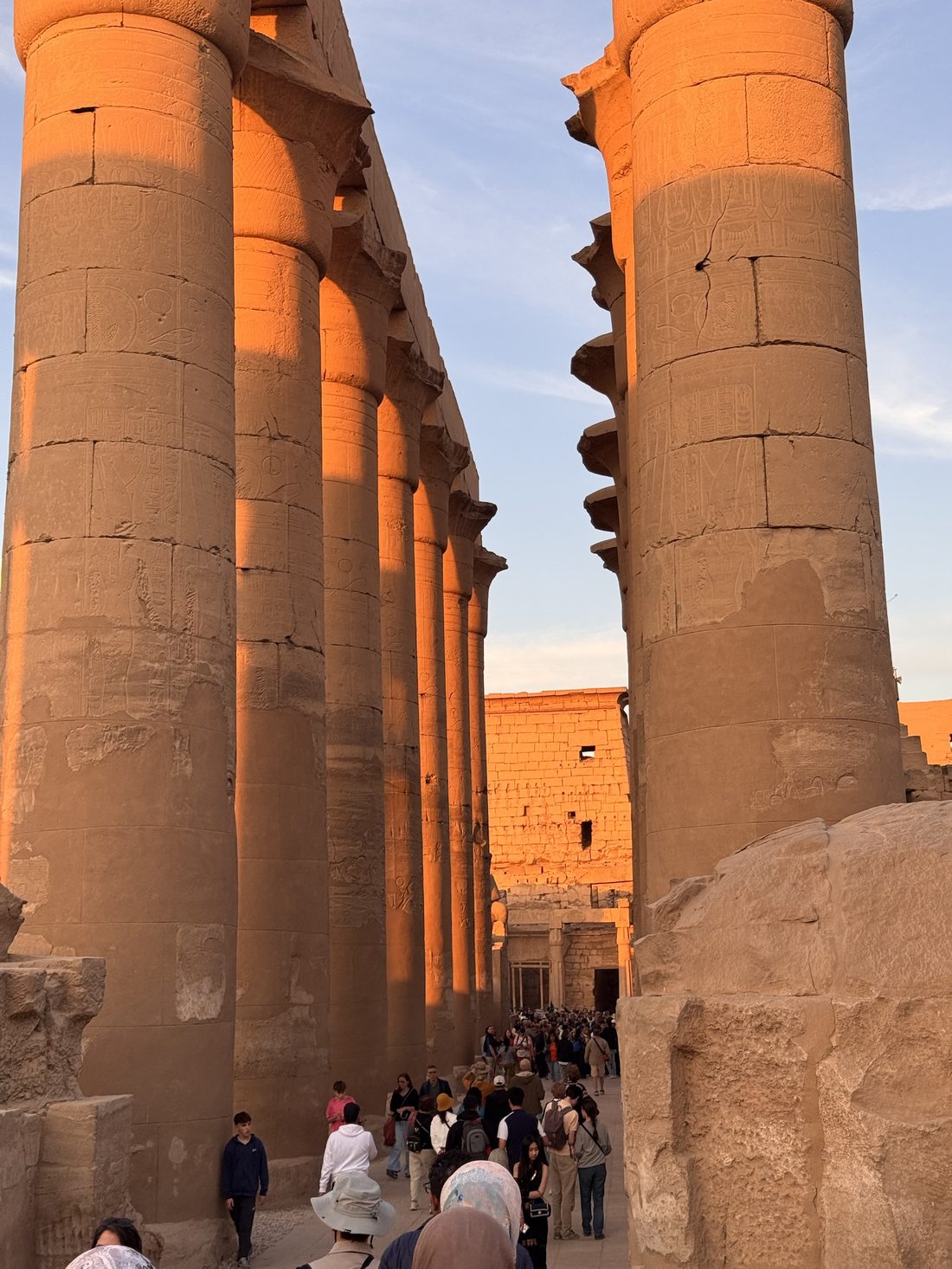
On the east bank of the Nile, in the middle of the modern town of Luxor, a temple that has never stopped being used. The ancient Egyptians called it Ipet-resyt, the southern sanctuary. Construction began around 1390 BCE under Amenhotep III, who built the inner sanctuary and the Great Colonnade. Tutankhamun and Horemheb finished decorating that colonnade a generation later. Ramesses II then added the whole entrance sequence: a peristyle court, a pylon sixty-five metres wide carved with his account of the Battle of Kadesh, and colossal statues of himself flanking the gate.
Two granite obelisks originally stood in front of that pylon. One is still there. The other has stood in the Place de la Concorde in Paris since 1836, a gift from Muhammad Ali Pasha, shipped down the Nile and across the Mediterranean at a cost that reportedly ran into millions of francs.
The temple was built for one event above all others: the Opet Festival. Once a year, the statues of Amun, his wife Mut, and their son Khonsu were carried from Karnak Temple to Luxor, along a processional avenue lined with sphinxes that ran for roughly two and a half kilometres. The point of the festival, as far as it can be reconstructed, was the renewal of the king's divine authority. It is carved in detail on the Colonnade walls: priests, musicians, boats on the water.
Then it kept getting reused, by everyone who came after.
Alexander the Great had a shrine built inside claiming his own coronation here, though the sources doubt he personally travelled this far south. By the late third century CE the Romans had folded the temple into a legionary fort and were worshipping the emperor in a converted hall; the painted plaster from that period is still visible, badly damaged, on the walls. Christian communities later built a church inside the same courtyard. In the thirteenth century, when centuries of Nile silt had buried most of the temple up to roof height, a mosque was built on top of the remaining high ground, dedicated to a Sufi saint named Abu al-Haggag, who died in 1245. Nobody moved the mosque when the temple was excavated beneath it. It is still an active place of worship today, standing on a ledge partway up the temple's own accumulated debris.
Systematic excavation began in 1884 under the French Egyptologist Gaston Maspero, uncovering courts and colonnades that had been buried under a village for centuries.
The sky here
This is the part I did not expect to find, and it is the reason this page exists rather than just being a travel note.
Egyptian temples are frequently aligned to solar events, and Luxor's neighbour Karnak has a well-documented alignment to the mid-winter sunrise, first proposed by the astronomer Norman Lockyer in 1894 and refined by later researchers. Luxor Temple should, in theory, do the same. It does not, cleanly.
The temple's axis is not straight. Amenhotep III's original core points in one direction; Ramesses II's later additions, the court and pylon at the front, sit on a noticeably different azimuth. A 1937 survey by Alexandre Varille and Robert Schwaller de Lubicz first drew attention to the bend in detail, and more recent academic analysis has confirmed it is real and measurable, not a surveying error. What nobody has settled is why.
One paper on precessional effects in ancient astronomy, reviewing the case directly, concludes that it remains as yet unclear whether the bend can be tied to an astronomical shift at all, as opposed to a simpler explanation: the front of the temple needed to face the Nile and the direction processions arrived from, while the inner sanctuary kept an older alignment fixed by Amenhotep III's builders. Both readings are defensible. Neither is proven.
Schwaller de Lubicz, the same researcher who first surveyed the bend precisely, went on to argue in his later work that Luxor Temple's proportions map onto the human body, that the whole ground plan is a kind of architectural anatomy. Mainstream Egyptology does not accept this, and I am not presenting it as established.
But I stood at the point where the axis visibly kinks, where you can see the front half of the temple pointing very slightly away from the back half, and I understood the impulse. A building that took three dynasties, an occupying empire, and a medieval saint to finish, and that still bends partway through like it changed its mind, does not feel like an accident. What if it wasn't one, and we simply do not yet have the framework to read what the change was for?
What is still open
Why does the axis bend?
Covered above. Astronomical realignment and practical necessity both remain live explanations, and the honest state of the evidence is that nobody has closed this one.
Did Alexander actually come here?
His shrine, inside the temple, claims his coronation as pharaoh took place at Luxor. Most historians think it more likely that local priests performed the ritual by proxy, or that the claim was made for political effect without Alexander ever travelling this far up the Nile. There is no independent record settling it either way.
What exactly was the royal ka, and what happened to it in this building?
Part of the temple, its function debated in detail by the Egyptologist Lanny Bell, appears to have been built around the cult of the pharaoh's royal ka, a kind of divine life force distinct from the king's personal identity, renewed here rather than simply inherited. The broad idea is accepted. The precise ritual mechanics, what was actually done in that part of the temple and to what effect, are reconstructed from fragments and remain a live scholarly question.
How much of ancient Thebes is still under the modern town?
The temple itself was buried under houses and a marketplace until 1884. Luxor is a living city built on top of a capital that operated for well over a thousand years. Excavation happens where the modern town allows it, which is not everywhere.
Going yourself
What I'd tell a friend booking a trip to Luxor. Check current hours and prices before you go.
- When
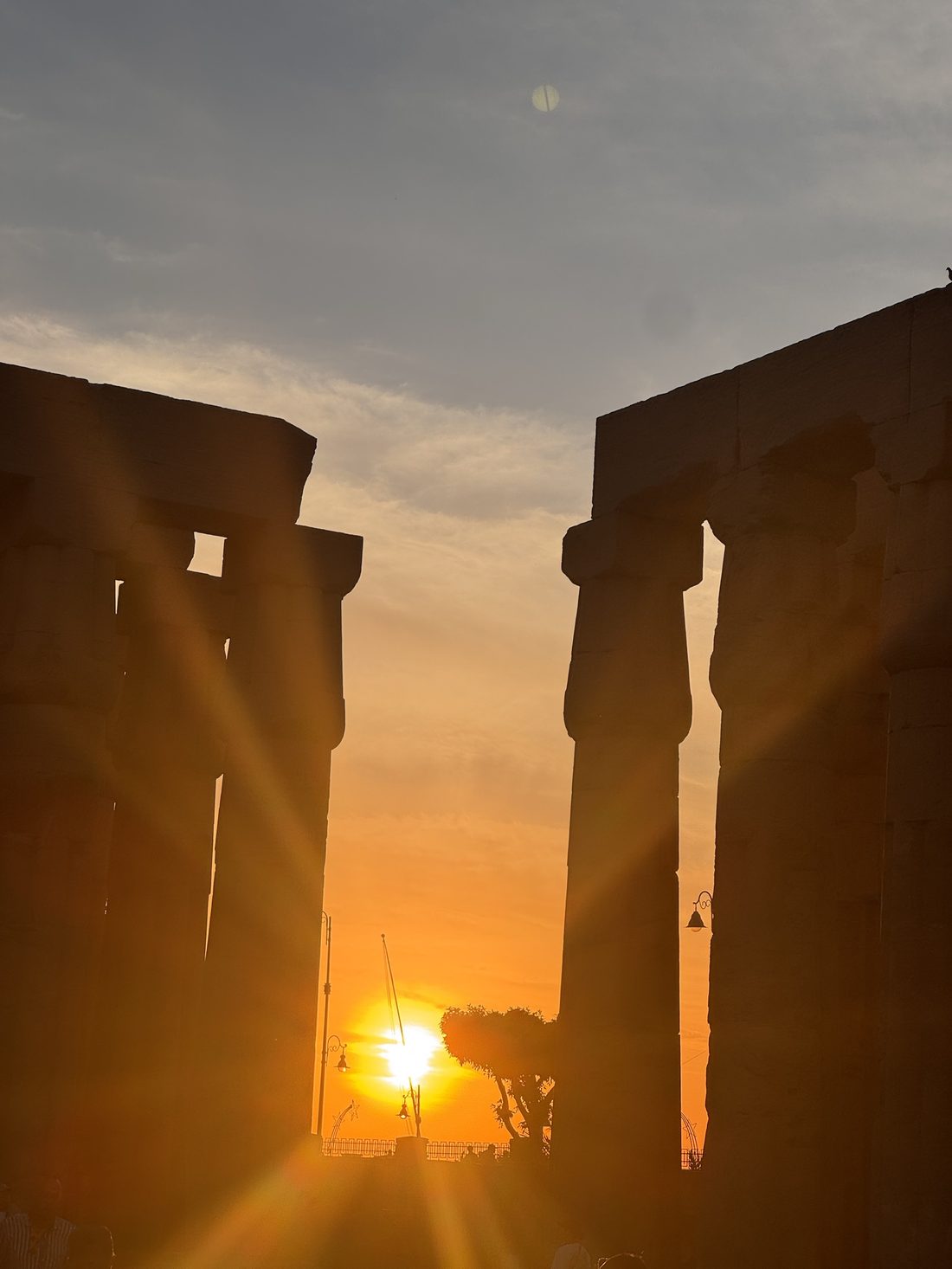
- Late afternoon into sunset. The temple is lit at night and stays open into the evening, and the light on the sandstone at golden hour is worth planning around.
- Pair it with Karnak
- The two temples were built to be experienced together, connected by the Avenue of Sphinxes. The avenue itself has been progressively cleared and reopened in recent years, so check whether it is walkable when you go, rather than only taking a car between the two.
- Look for the mosque
- Easy to walk past without registering what it is: the Abu al-Haggag Mosque sits on a raised platform partway up the temple's own ruins, a physical record of how deep the sand once was.
- The bend
- Stand at the join between Amenhotep III's colonnade and Ramesses II's court and look down the length of the temple in both directions. The change in axis is visible to the eye once you know to look for it.
Sources
- Bell, L., "Luxor Temple and the Cult of the Royal Ka", on the temple's role in kingship renewal.
- Egyptian Ministry of Tourism and Antiquities, official description of Luxor Temple's construction phases.
- Institute for the Study of Ancient Cultures, University of Chicago, on the Mosque of Abu'l Haggag and the temple's continuous use.
- Lockyer, N., The Dawn of Astronomy, 1894, the earliest systematic study of Theban temple orientation, discussed and revisited in later precessional analysis.
- Analysis of the Luxor Temple's bent axis and its uncertain astronomical significance, in published work on precessional effects in ancient astronomy.
- On the Luxor Obelisks and their 1829 to 1836 relocation to Paris.
Visited in person. Last reviewed September 2026.