The long heads
A thread · Artificial cranial deformation, and the stories told about it
Elongated skulls turn up on several continents, and the custom behind most of them is real, documented and old. The reasons people gave differ from place to place. I found no record of anyone reshaping a child’s head to look like one particular person, and no evidence that these skulls are anything but human.
- Earliest written account
- Hippocrates, c. 400 BCE
- Still practised
- into the 20th century
- Type of connection
- mostly convergence
- Open questions
- 3 logged
What is being done, and to whom
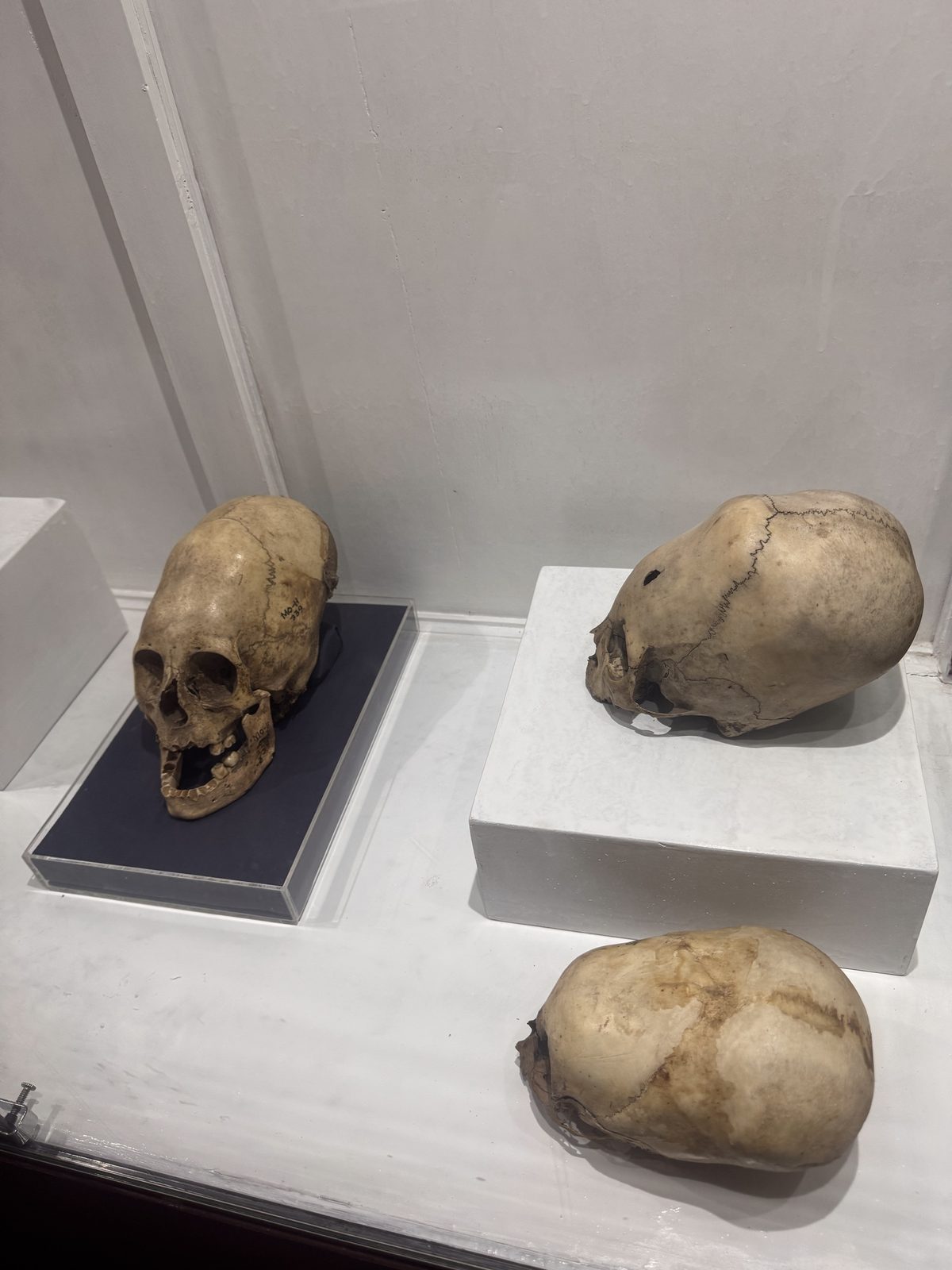
Artificial cranial deformation means reshaping a baby’s skull on purpose, by steady pressure on bones that have not yet set. Wikipedia lists the forms: flat, elongated (the head held between boards), round (wrapped in cloth) and cone shaped. It usually began about a month after birth and lasted around six months, sometimes years.
The health picture is not settled. Vera Tiesler, who studies Maya body modification, says in a History.com piece that mothers and midwives generally knew what they were doing and that it was not painful, and that other studies found no general effect on health or cognition. Wikipedia reports a Peruvian study that found no significant difference in cranial capacity. For the Mangbetu, one source calls the health effects “widely debated”.
Where, and why: what the sources say
| Where and who | When | Reason given or proposed | How firm |
|---|---|---|---|
| Macrocephali (“long-heads”), north-east of the Black Sea | Hippocrates, c. 400 BCE | Hippocrates says: “They think those the most noble who have the longest heads.” | A Greek outsider’s written account, so secondhand, but the earliest I found |
| Alchon Huns, Bactria and Gandhara | 5th to 7th century CE; Khingila c. 430 to 490 | Probably group identity. Elongated skulls appear in most ruler portraits on their coins, most clearly on Khingila’s, in place of Sasanian-style crowns, and set them apart from the Kidarites | Firm that the shape is shown. The identity reading is an interpretation |
| Maya | Not dated in the pieces I read | Protecting the child and keeping the soul in (the soft spots were covered), a rite of passage out of the cradleboard, a possible echo of the creation myth in which gods make people from maize, and shapes that seem to follow language groups | Tiesler’s readings, several at once, none settled |
| Callagua, southern Peruvian highlands | AD 1100 to 1450 | Heads shaped to resemble sacred mountains. A 16th-century Spanish scribe says it honoured Collaguata, a volcano seen as their ancestral home. Matthew Velasco argues the shape also gave social advantages, such as a claim on land and resources | A colonial source plus a modern argument |
| Andes more widely; the Chama of north-eastern Peru | Inca period; Chama still practising in the mid-20th century | The head as seat of spiritual life, protection from harmful influences, and keeping a vital force (animu) in the body. Jérôme Thomas (Montpellier, 2017) warns against reading modern ideas of identity back into older Andean societies | One recent research view |
| Visayan and Bikol peoples, Philippines | Described from 1604 (Diego Bobadilla) | Beauty (a broad face with a sloping forehead) and noble rank (tumao), though it is unclear whether it stayed limited to nobles | Early Spanish description, modern reading |
| Malakula, Vanuatu | Not dated in my source | A long head read as a sign of more intelligence, higher status and closeness to spirits | Ethnographic reports, through Wikipedia |
| Mangbetu, north-eastern Congo (lipombo) | Photographed in 1947; fading from the 1950s | A mark of beauty for women and a status symbol tied to beauty and intelligence. The Smithsonian says neighbouring groups copied it, especially ruling classes | Documented in photographs and museum objects. The belief about intelligence is a belief, not a finding |
Everything here is from secondary sources: Wikipedia’s article on artificial cranial deformation and its page on the Alchon Huns, the History.com and University of Montpellier articles, and a Snopes fact-check for the Mangbetu. Apart from Hippocrates, the reasons are researchers’ interpretations, not statements by the people who did it.
Why did they do it? Four kinds of answer
Sorted loosely, the reasons in the table fall into four groups. A marker of who you belong to (Alchon, Maya, possibly Tanegashima in Japan). A marker of rank or an ideal of beauty (Macrocephali, Philippines, Mangbetu). Protection of the child and its soul (Maya, Andes). A sacred shape, copied from a mountain or a myth (Callagua, Maya).
They do not compete. One custom can be beauty, rank and protection at once, and the people who did it may not have separated them. Tiesler also offers a guess about how it began: that parents noticed that cradles which flattened the back of the head left a shape they came to like. That is a theory, and I found nothing that tests it.
Did they want to look like someone?
It is the obvious question, and the sources give four different answers depending on who “someone” is.
Like the people at the top. Best supported. Hippocrates says the Macrocephali held the longest heads to be the most noble. The Smithsonian, as quoted by Snopes, says neighbours of the Mangbetu copied lipombo, especially their ruling classes. The Alchon rulers put the shape on their coins. In all three a type of person is being imitated, or displayed, not a named individual. Hippocrates also says the custom started as an act of shaping, and that people then admired the result, so I cannot tell from this who copied whom first.
Like something sacred. Possible, and interpretive. The Callagua shaped heads like their mountain, according to a Spanish scribe. Tiesler points to Maya literature and images of gods shaping heads when they make people. What is being matched here is a landscape or a divine pattern, not a person.
Like a group that was naturally long-headed. An old idea, weak. Wikipedia reports a theory that some peoples imitated groups whose skulls were long by nature, and cites Rivero and von Tschudi describing an Inca mummy with a fetus as evidence. The University of Montpellier article says von Tschudi disputed that the deformations were artificial at all, and Heiser notes that fetal skulls are poor evidence because they are not fully formed. I have not read the originals, and I would not lean on this.
Like one particular person. Not documented. I found no source where people reshaped heads to resemble a named ruler, god-king or visitor. A fashion set at court can spread, but the Amarna case below is art, not skulls.
Three different things get called a long skull
Shaped by binding, which is what the sections above are about. Binding can leave indentations in the bone: Heinrich Rathke described this in 1843 on skulls found in the northern Caucasus.
Naturally long-headed. Anders Retzius (1796 to 1860) defined the cephalic index, head width divided by length, and the low end of the scale is called dolichocephalic, “long-headed”. Nineteenth-century anthropologists sorted ancient skulls into races with it. Franz Boas, around 1910 to 1912, showed that the index of immigrants’ children differed from their parents’, which points to an environmental effect, and as a racial measure the index is now largely rejected. Carleton Coon was still using it in the 1960s, when Wikipedia says it was “largely discredited”.
Medical. Craniosynostosis, early fusion of the skull sutures, changes head shape. Heiser notes it can be missed on X-rays.
The popular retellings mix these three freely. That matters for Malta below, where the word on the record is of the second kind.
The stories told about long heads
| The claim | Who | What the sources show | Status |
|---|---|---|---|
| Elongated skulls are alien or hybrid | Brien Foerster, L. A. Marzulli and television retellings; the Paracas case is on the Peru page | The shape is explained by binding. The DNA claims behind it are unpublished, and contamination was not ruled out | Not supported |
| They are the Nephilim of Genesis | Popular Nephilim writers, among them Marzulli | The biblical scholar Michael Heiser wrote in 2016 that he knows of no verse linking skull shape to the Nephilim, and called the idea bogus | Not supported |
| Atlanteans had long skulls and seeded Egypt and Peru | Later Atlantis writers: Donnelly (1882), Blavatsky (1888), Cayce | Plato’s Timaeus and Critias, c. 360 BCE, are the only primary sources. The Wikipedia page does not say Plato described the Atlanteans’ bodies. Donnelly placed the origin of all ancient civilisations there; Blavatsky wrote of Atlanteans as a “root race”. I found no source that gives them elongated skulls | Not verified: no source found for the skull part |
| The early inhabitants or rulers of Egypt had long skulls | Closest seed: Flinders Petrie’s “Dynastic Race”, early 20th century | Petrie argued from skeletons at Naqada for an invading elite with larger skeletons and larger cranial capacity. Not long skulls as such. Egyptology dropped the idea: state formation is now seen as mainly local. A 2025 genome of one Old Kingdom individual (2855 to 2570 BCE) showed mostly North African Neolithic ancestry and 20 to 24 percent from the eastern Fertile Crescent, with no sign of replacement. One person is not a population | Not supported |
| Akhenaten’s family were a separate long-headed line | Popular retellings. I did not trace one origin | The art is real: a bulbous head on a long neck, copied in depictions of courtiers (Fitzwilliam Museum). Marfan’s syndrome “has been suggested” there without a source. In 2008 Irwin Braverman (Yale) proposed aromatase excess plus craniosynostosis, from artwork alone, since no mummy of Akhenaten exists, and said DNA from relatives’ mummies could test it. That a whole court shares one head shape in art reads to me more like style than anatomy, but that is my reading | Partly right: the images are real, the cause is open |
| The Ħal Saflieni skulls on Malta were deliberately elongated | Popular and tourist retellings; some say aliens or a cover-up | Temi Zammit described them in 1926 as “of the long variety (dolichocephalic)”, which is the cephalic-index word, not a statement about binding. Heritage Malta says fewer than 20 of an estimated 7,000 individuals survive, and its research project, announced around 2019 (my inference from the page), set out to “set the record straight”. It confirms no deliberate elongation. The osteoarchaeologist Bernadette Mercieca called them “pretty normal crania” in 2019 and said angle can make them look elongated. Wikipedia, by contrast, says a small percentage show abnormal elongation | Not verified. The sources disagree and I found no published results |
Status as of 18 October 2026. “Not verified” means I could not find a source, not that the claim is false. The Malta quotations come from Heritage Malta’s own news item and a 2020 MaltaToday opinion piece that reports Mercieca’s interview; I did not read the interview itself. The Hypogeum is described on the Malta page.
What if the long head keeps being reinvented because it is a very good signal? It is made when the person cannot refuse, it is visible across a room, it cannot be taken off, and it cannot be faked later in life.
I am speculating about the custom, not about any people or person. Why it is worth asking: the same act turns up on several continents with different stated reasons, while the stated reasons often involve identity or rank. What supports it: Hippocrates on nobility, the Alchon coins, the Mangbetu ruling classes, the claim to land among the Callagua. What speaks against it: other reasons given are about the soul, mountains, beauty and protection, and one signalling story would flatten them. Thomas also warns against reading modern identity ideas into older societies. What would tell the readings apart: skeleton series from single sites, dated, showing who was shaped (everyone, or only some) and what they were buried with. What stays unknown: why it started, and whether it was invented once and spread or many times.
What is still open
Where and why did it start?
The oldest candidate is from Shanidar Cave in Iraq, put in the ninth millennium BCE, but Chech, Grove, Thorne and Trinkaus (1999) contested that reading. Elongated skulls from Neolithic south-west Asia are also read as deformation. I found no firm date or reason for a first case, and Tiesler’s cradle idea is a theory.
What do the Ħal Saflieni skulls show?
Heritage Malta says fewer than 20 survive. Heritage Malta and Mercieca say they look ordinary, and Wikipedia says a small percentage are abnormally elongated. A study led by Ronika Power of Macquarie University was announced to settle it, covering health, diet and ancestry. I found no published results.
What explains the Amarna heads?
Style, medicine or both. Braverman’s proposal rests on artwork and is untested as far as I read. I did not check whether DNA work on the mummies of relatives has addressed it since.
Sources
- Wikipedia: Artificial cranial deformation (forms, regions, Shanidar, Philippines, Vanuatu, the imitation theory), Alchon Huns, Macrocephali (Rathke, 1843), Cephalic index, Dynastic race theory, Atlantis and Ħal Saflieni Hypogeum. Encyclopedia pages, secondary sources.
- Hippocrates, On Airs, Waters, and Places, part 14, in the MIT Internet Classics Archive, translation by Francis Adams as named on the page. Quoted as my text-fetching tool returned it.
- History.com, on ancient cranial modification (Tiesler, Callagua and Velasco, Paracas, Maya reasons). Journalism, not a paper.
- University of Montpellier, Cranial deformation: practiced by the Incas, it is also a universal custom (Jérôme Thomas, 2017; Chama; von Tschudi).
- Snopes, on the Mangbetu and head elongation, for the meaning, the 1947 photograph and the Smithsonian’s remark.
- Michael Heiser, Elongated skulls aka artificial cranial modification, it has nothing to do with Nephilim, 9 April 2016. A blog post by a biblical scholar.
- Heritage Malta, Ħal Saflieni skulls to be studied (undated; I infer 2019), and R. Vassallo in MaltaToday, Either they were human… or we’re aliens, 29 December 2020, which quotes Mercieca. An opinion piece, used here only for her quoted words.
- The Fitzwilliam Museum, Amarna art, and Yale School of Medicine, on Irwin Braverman’s hypothesis (20 May 2008). A museum page that cites no one, and a press release for a conference talk.
- The Peru page on this site, for the Paracas DNA claims and my own photographs.
A thread, not a place. Page opened and last reviewed 18 October 2026. Written from secondary sources and one translation of Hippocrates; I have not read the original papers or the Greek. The photograph is my own, taken at the Museo Inka in Cusco. If something here is wrong, tell me and it gets corrected on the page with a note saying what changed.